

News Center
Application of Styrenated Phenol in the Epoxy Field
In the field of epoxy resin and curing agent formulations, finding environmentally friendly alternatives to nonylphenol (NP) has attracted considerable attention in recent years.
In the 1940s and 1950s, with the commercialization of epoxy resins and the widespread use of alkylphenol ethoxylates (APEOs), nonylphenol began to be used on a large scale. However, due to its endocrine-disrupting effects, environmental persistence and potential to cause infertility, coating industry associations in Nordic countries such as Denmark voluntarily prohibited the addition of nonylphenol to paints starting in the mid-1990s.
In 2004, the European Union issued Directive 2003/53/EC, stipulating that the content of nonylphenol and nonylphenol ethoxylates (EPEO) in industries such as textiles and leather must not exceed 0.1%.
Between 2016 and 2021, the EU adopted amendments to the REACH Regulation (REGULATION 2016/26), fully prohibiting the import of textiles containing 0.01% NPEO from February 3, 2021.
On March 1, 2023, six Chinese government departments, including the Ministry of Ecology and Environment, issued the List of New Pollutants Subject to Priority Control (2023 Edition), comprehensively prohibiting the use of nonylphenol as a pesticide adjuvant, in the production of nonylphenol ethoxylates, and in cosmetics.
Although the epoxy coatings industry has not been subject to an outright ban, increasing environmental compliance requirements throughout the upstream and downstream supply chains have placed considerable pressure on the industry. Since 2023, China's epoxy industry has begun phasing out nonylphenol and seeking alternatives.
Many years ago, KUMHO PETRO began promoting styrenated phenol as a replacement for nonylphenol in the epoxy field. It can serve as a 1:1 replacement.
With a phenolic hydroxyl value of 230–260, it provides equivalent curing acceleration performance. It promotes the ring-opening reaction of epoxy groups and accelerates amine curing at room or low temperatures.
Its low viscosity allows it to act as a diluent, reducing the viscosity of amine components.
Its strong hydrophobicity helps prevent whitening or oily surface formation on coatings caused by amine curing agents absorbing carbon dioxide and moisture. This helps maintain high gloss and surface hardness in epoxy flooring and high-build coatings.
Its hydrophobic, moisture-resistant, chemical corrosion-resistant, anti-aging and UV-resistant properties make it suitable for outdoor protective applications, including marine vessels, offshore heavy-duty corrosion protection and concrete substrates.
Styrenated phenol is available in mono-, di- and tri-styrenated forms. Mono-styrenated phenol is primarily used in epoxy systems, while di- and tri-styrenated phenol offer better anti-aging and UV resistance. An increasing number of customers have also started using these products.
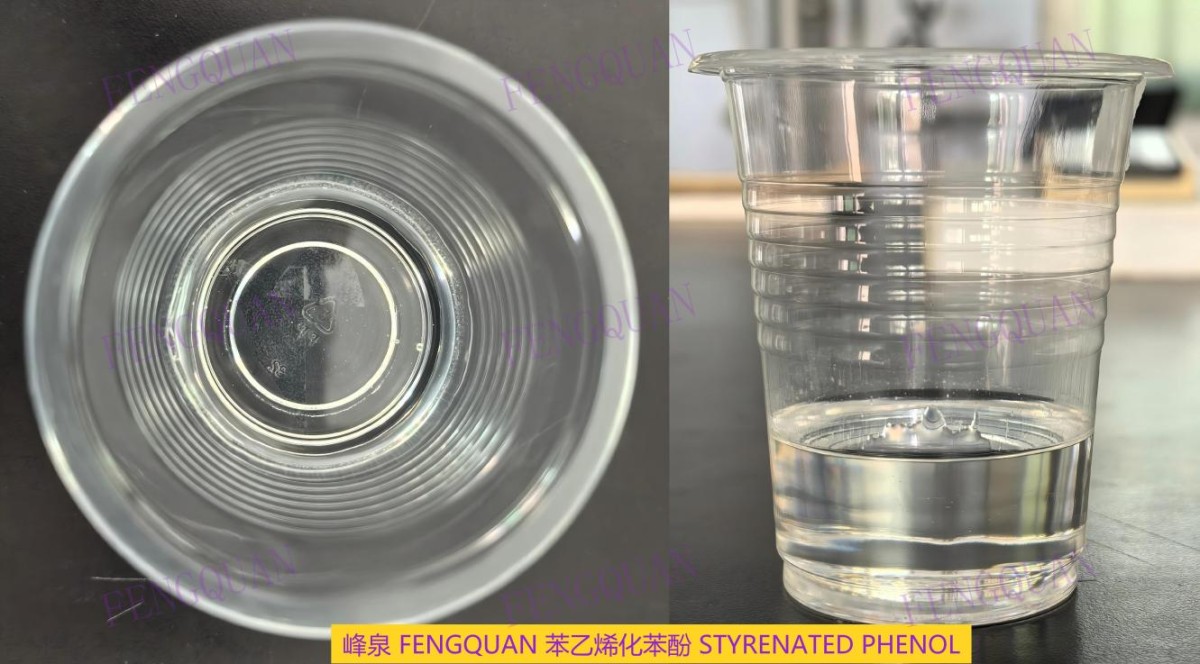
Fengquan manufactures mono-, di- and tri-styrenated phenol to meet the needs of different customers.
The above information has been compiled by Fengquan. We welcome your comments and suggestions on any inaccuracies.
Contact:
WeChat: 008617562936720
Email: SALES@SDFQXCL.COM